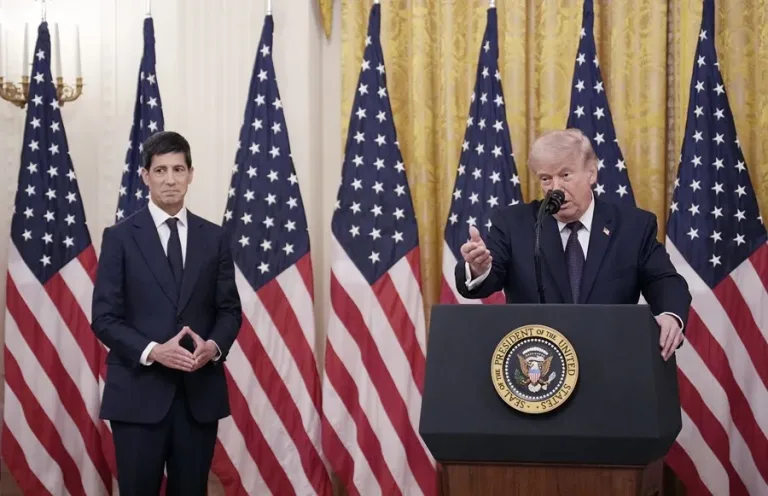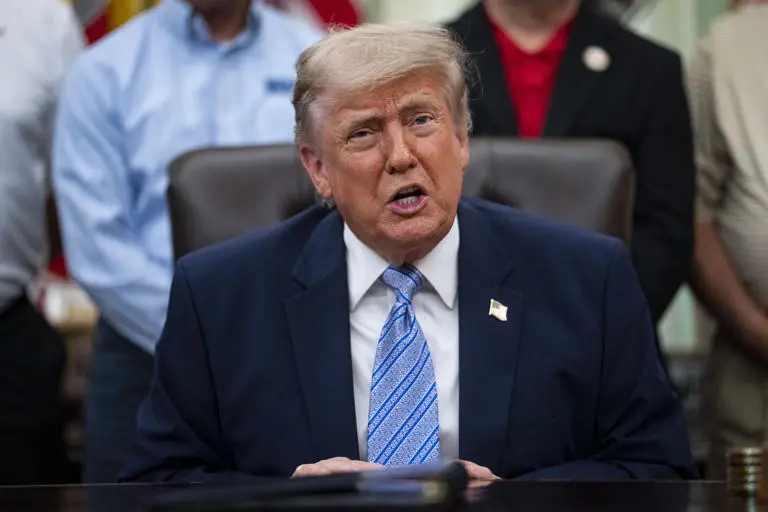
Donald Trump once again placed Puerto Rico at the center of U.S. political debate. This time, the president described the eventual statehood of the island as “a disaster.” The phrase was not isolated. It was part of a broader offensive against proposals that, according to him, would benefit the Democratic Party and alter the balance of power in Washington.
The statements were made Thursday during a press conference in the Oval Office. There, Trump warned that if Democrats regain control of Congress and the federal government, the country would enter a critical phase. In that scenario, he mentioned as threats Puerto Rico statehood, Washington D.C. statehood, changes to the Supreme Court, and modifications to the electoral system.
The comment not only revives an old institutional conflict. It also exposes how the discussion about Puerto Rico continues to be treated through an electoral lens. For Trump, the incorporation of the island as a state would mean an expansion of Democratic power. For many Puerto Ricans, in contrast, the debate revolves around political rights, representation, and full citizenship within the U.S. federal system.
Why Does Trump Consider Puerto Rico Statehood a “Disaster”?
The president’s main objection is linked to the political impact of this possible transformation. Trump argued that if Puerto Rico becomes a state, it would obtain votes in the Electoral College. It would also have full representation in Congress. In his view, this would strengthen Democrats and permanently alter the correlation of forces in national politics.
The argument is not new, but it gains strength at a time of high polarization. Puerto Rico has been an unincorporated U.S. territory since 1898. This means it is under American sovereignty, but does not have the same status as a state. Its inhabitants are U.S. citizens, but cannot vote in presidential elections and do not have voting representation in the federal Congress.
This is why, whenever the statehood debate arises, two opposing views appear. One focuses on the structure of power in Washington. The other concentrates on the political inequality facing the island. Trump clearly chose the first. His warning presents statehood as a national threat, not as a discussion about democratic rights for more than 3 million U.S. citizens.
What Does This Debate Have to Do with Senate Filibustering?
The president’s words must also be read within another key dispute: the future of the filibuster, or Senate legislative obstruction mechanism. That rule allows one to block or delay bills by generally requiring a majority of 60 votes for an initiative to advance. In practice, it functions as a barrier to deep reforms when there is no broad political consensus.
Trump has previously insisted on eliminating that rule, at least during moments of institutional crisis. In October 2025, he asked Republicans to end the filibuster to unblock federal government closure. That episode caused a defunding of public institutions for 43 days, between October 1 and November 12. Pressure to change Senate rules emerged then as an emergency exit.
However, Trump now uses that same debate to warn about future consequences. According to his approach, eliminating the filibuster to solve an immediate problem could later open the door to more ambitious Democratic initiatives. Among them, Puerto Rico statehood. In other words, the president presents the rule change as a strategic risk. He believes that what may serve Republicans today could consolidate the power of his rivals tomorrow.
What Would It Mean for Puerto Rico to Become a State?
Statehood would mean a profound change in the relationship between Puerto Rico and the United States. The island would cease to be an unincorporated territory and would take a full place within the Union. This would imply voting representation in the House of Representatives and in the Senate
Investigating Your Remittances? Alert Over Transfer Controls in USA
President Trump signed an executive order requiring U.S. banks to closely monitor international fund transfers...
Kevin Warsh, el nuevo presidente “independiente” de la Reserva Federal
Jefe de la Reserva Federal dice que será reformista tras solemne juramentación en la Casa...