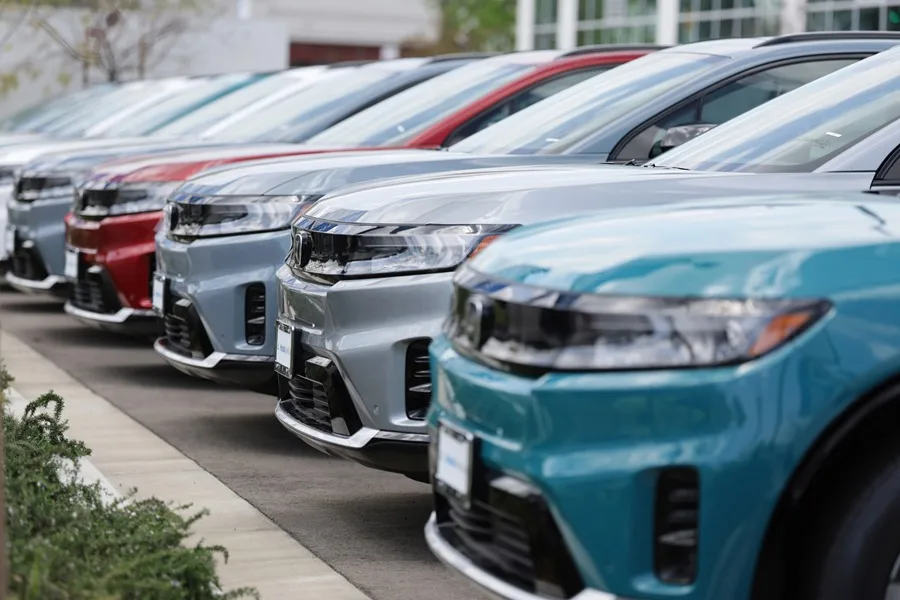
The U.S. automotive market is experiencing a transformation driven by consumers’ wallets. Consumer interest in electric vehicles (EVs) experienced a significant surge during April 2026. According to a study by consulting firm JD Power released this Thursday, the rising cost of fossil fuels is the main driver of this change. Although overall sales have shown signs of stagnation, the reality at gas stations is forcing many drivers to reconsider their next purchase.
The report reveals that 26% of new vehicle buyers stated in April that it was “very likely” they would consider an electric vehicle. This figure represents an increase of three percentage points compared to data recorded in March. This increase brings to 25% the average proportion of buyers who, so far in 2026, declare themselves “very inclined” to this technology. In 2025, this figure remained one point below, confirming an upward trend in American consumer mentality.
Despite this renewed enthusiasm, the path toward mass electrification is not without obstacles. Data from Cox Automotive shows that electric vehicle sales in January of this year totaled 66,276 units. This represented a decline of 29.9% compared to the same month in 2025. However, in March sales reached 82,629 vehicles. Although still 24.7% less than the previous year, the monthly recovery suggests that gas prices are altering user priorities.
What are the main obstacles to electric vehicle adoption?
Despite interest, structural barriers are slowing the final purchasing decision. The availability of charging stations remains the number one concern for Americans. 46% of respondents cited lack of infrastructure as the main reason for rejecting an electric vehicle. However, there is a positive note: this percentage has dropped six points compared to the previous year. This suggests that the expansion of the charging network is beginning to be perceived by the public, although not as quickly as necessary.
Charging time is the second most mentioned obstacle, with 44% of responses. Drivers are accustomed to the immediacy of filling a gas tank in a few minutes. Therefore, prolonged waiting in front of a charger remains unattractive to nearly half of buyers. Finally, the purchase price appears as the third major barrier. 42% of consumers who reject electric models do so because of their high initial cost compared to combustion vehicles.
These concerns persist despite the industry’s attempts to reduce costs. A determining factor in this perception was the decision by the U.S. Government in September 2025. At that time, tax incentives of up to $7,500 for the purchase of these models were eliminated. Without that direct financial support, the sticker price has become a critical factor that many are unwilling to ignore, especially in an inflationary context.
What expectations do the most skeptical consumers have about this technology?
The JD Power study, based on responses from 8,154 consumers, reflects a very high level of demand from skeptics. 56% of respondents are unwilling to pay any premium for an electric vehicle compared to a traditional one. For this group, sustainability does not justify extra spending in their family budget. Additionally, 73% of buyers demand a minimum range of 500 miles (approximately 805 kilometers) per charge, a figure that few current models achieve at an affordable price.
The comparison with traditional service stations is inevitable for the average user. 43% of participants expect charger availability to be exactly equivalent to gas stations. This expectation creates constant pressure on both public and private sectors to accelerate the installation of charging points on highways and rural areas. Without visual and logistical parity with petroleum, the “fear of running out of power” remains a significant psychological barrier to adoption.